My digital home on the interwebs!

Latest Posts

Showing posts with label minimalism. Show all posts

Thursday, 25 March 2021

Minimalism Rulebook


Being an engineer, a data analytics guy, and then a strategy professional, I strongly believe in finding a proper method or framework for doing things, instead of following a "hit and trial" method. 


When I started my learning journey about minimalism, I searched a lot on google for finding a Minimalist Rulebook. I honestly believed that there should be a set of 10-20-50 rules that you need to follow to become a minimalist. I scoured a lot of websites out there, subscribed to their email lists, and downloaded many free PDFs that they offer. However, most of them turned out to be guidebooks on How to declutter your life. 


Well, most of them were good for that purpose, but decluttering is only a very small sub-set of a minimalist lifestyle. No doubt it is the most visible part, but eventually, it is only a sub-set of the overall philosophy. Also, instead of all those long PDFs, I rather prefer to go and read a 15-word blog post from The Minimalists 


The easiest Way to Organize Your Stuff … is to get rid of most of it.


Umm, so there is really no rulebook?


Rules Lists Notes
Dan Dimmock on Unsplash


The more I study about it, the more I realize it is not only inaccurate but quite pointless to have a minimalist rulebook. 


Minimalist living is not about who can lead a normal life with the least amount of possessions. Rather, it is about owning or being attached to things consciously. Own 100-200-300 things, but each one of them should add value to your life. However, what adds value to my life could be absolutely useless for you. Context matters. For example, I love tea and own several pieces of tea-making ingredients and equipment. But in a coffee drinker's life, all of this is just clutter! 


To add to it, I realized what adds value and what doesn't is a point function. Meaning, it is true only at a given point in time. When I shifted to where I live now, I carried my Xbox thousands of kilometers with me. I could not imagine a life without it. However, today morning I found it stuffed at the back of a closet, untouched since almost a year ago. 


So what should we do?

In any dictionary, Minimalism is not written as the opposite of the word Want. Rather, Minimalism is defined as the process of owning things more consciously and questioning the value of things we still hold on to from the past. 


From my personal experience, what works better for the human behavior is defined, scheduled processes than rules or my pet peeve - new year resolutions. Taking an example from my other passion - personal finance - 


  • Process: Following a Systematic investment plan (SIP) or Dollar Cost Averaging (in American parlance) is a great process to automate long term savings while making sure the amount earmarked for savings is not used for wasteful expenses - you can't spend what is already deduced from your account
  • Changing context over time: To assess if your current investment profile still aligns with your long term values, it is recommended to periodically balance your exposure between different asset classes (debt / equity etc.) once a year or so


Similarly, for the minimalism practice, each one of us has to answer our own questions and develop our own processes - 

  • How do we decide if a thing adds value to our life or not?
  • How do we make our purchase decisions?
  • What to do with just in case items in our home and life? (the drawer filled with 50 different screws and 20 different chargers and wires!)
  • How do we learn to co-exist with family / friends who do not believe in minimalist lifestyles?

and so on...

Once you have clear answers to such questions, you will realize that you don't really need a Minimalism Rulebook. All you need to do is 

  • remember these key values before making any purchase decision in life / while periodically reviewing your possessions
  • revisit these questions periodically, to evaluate if your answers have changed  
 .. and that is how you truly take your first steps in adopting the minimalism philosophy. 

Till we meet again - Au revoir! 

PS: Do check out the Books page on the blog [Link]

Tuesday, 10 November 2020

Hedonic Adaptation

I am currently following a course on Coursera: The Science of Well Being. It has been one of the most famous online courses by Yale, to date, and my favorite so far. If you haven't checked it out, I recommend you do it. 


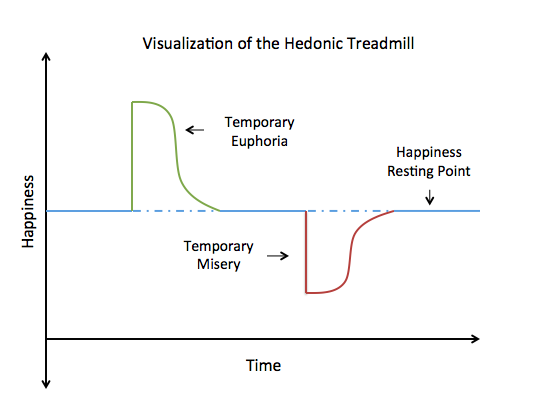
There is a concept discussed in almost every lecture 'Hedonic Adaptation'. Which, simply put, states that 


On average, a person's happiness remains almost linear throughout his life. We get used to everything.


We envision, that a big positive event such as buying your first car will make you really happy. Well, it does, but only for a few days. Let's say till the new car smell wears out or you get the first scratch on the bumper. 


On the other hand, we envision that those big negative events will make this life a living hell, well guess what, we get used to it as well. Do you remember the paranoia in April-May? Everyone was refreshing Worldometer 20 times a day, washing groceries with dish soap, and even crossing the street if you spot a pedestrian walking your way! ... and now, almost no one seems to care! 

Image Source kadampalife


Hedonic Treadmill

It is the exact same reason the concept is also referred to as the Hedonic Treadmill. We are running on a treadmill, trying to maintain the state of euphoria by chasing Instagram likes, buying new things, searching for those 15 minutes of fame. But alas, this survivalist brain of ours brings us back to where we started.  


I read a very interesting example today about this - We can now purchase and download all our favorite songs on our phones and can, and actually do listen to them whenever we want. But does it give the same burst of excitement if the song unexpectedly comes on the radio or you hear it being played in a car passing by?


This example can really be tied to the age-old adage that we hear from monks and minimalists. Experience over Things.   


Once you own a song, after the first few times, your brain knows it resides in your pocket, and you can listen to it anytime. Meh. Takes away the excitement. While, as is the case with all experiences, listening to it on the radio is a once in a while event, can not be done on-demand and actually has a surprise element to it! 


Can we alter the baseline?


I often found myself asking the following two questions during the lectures:


How did my happiness / life satisfaction baseline get set to a specific level? 


To be honest, I didn't find much conclusive answer to this question. Some studies say almost 50% of the weight is on genetics, the next 10% is on the conditions you have grown up in, and the rest 40% is what kind of personality we have, our thoughts, values, and so on. I figured, the baseline doesn't matter, if I can find an answer to the second question 


How do I play around with it? 


 Professor Laurie Santos gave several good pointers, but the following ones struck a chord with me. 

  • Savoring:  The act of stepping outside of an experience to review and appreciate it 
While having an experience, step out of it and realize that this activity was probably your dream for years, what seems like an unordinary thing now

  • Gratitude The quality of being thankful and a tendency to show appreciation for what one has 

Sounds like a small thing, but writing down 3-5 things every day that you are thankful for increases your happiness baseline for weeks! And sharing your gratitude with a person can yield months of increased baseline. 

And this method is Dwight Schrute approved as well 


And the last one, which was quite a counterintuitive one for me. Interrupt your positive experiences, and savor them by enjoying them in multiple sittings.


I actually didn't understand this one quite well, till I heard the subsequent example: Were TV shows much more exciting when we had to wait 1 week for the next episode, which was even further interrupted with advertisements? Or are they more enjoyable now with them playing in such uninterrupted mode than even Netflix has to ask - Are you really still watching this show?

Ending Notes

I still have about 3 weeks of the course to go. Will add here or in a new post if I find more such interesting nuggets. For now, I will leave you with my favorite quote of the week.


    A new car sticks around to disappoint you. But a trip to Europe is over. It evaporates. It has the good sense to go away, and you are left with nothing but a wonderful memory. --Dan Gilbert


    Monday, 12 October 2020

    What is minimalism?

    Like most of you, I spent the better part of 2020 in my pajamas, wearing the same 4-5 t-shirts throughout the lockdown and wondering about a lot of existential questions. Obviously, after exhausting the whole catalogue of Netflix. 


    With an extra 2-3 hours extra per day, thanks to reduction in travelling time - to and fro from work - I was able to dedicate a lot more time to reading. In addition to the usual financial markets stuff, I was forced to read a wide variety of topics just to keep myself engaged. 


    To my surprise, one of the topic that stuck started with reading en vogue book of the year by Marie Kondo. Though I also read a lot about the first principles behind it - the Zen way of life, minimalism, meditation and as Po would call it "inner peace". The only one that stuck was Minimalism.


    To be fair, we are not monks. We cant renounce stuff and live life like master Oogway. We must take what is good and practical to apply and enrich our life. 


    So how do you actually define Minimalism?

    First I present you the definitions from the learned ones, and then mine.


    Maybe you don’t need to own all this stuff. - Joshua Becker's Neighbor


    Minimalism is defined as a design or style in which the simplest and fewest elements are used to create the maximum effect. Minimalism had its origins in the arts—with the artwork featuring simple lines, only a few colors, and careful placement of those lines and colors - Andrew Ongaro 


    Minimalism is a tool to rid yourself of life’s excess in favor of focusing on what’s important—so you can find happiness, fulfillment, and freedom - The Minimalists


    It’s a way to escape the excesses of the world around us — the excesses of consumerism, material possessions, clutter, having too much to do, too much debt, too many distractions, too much noise. But too little meaning.  - Leo Babuta of the Zen Habits


    My definition is a derivation from the work of all these masters, and my MBA degree - Dude, its just Pareto Principle. Only 20% is enough to get 80% of the results! While we know this for business world, it is equally applicable in personal world as well.


    Plant
    Photo by Sarah Dorweiler on Unsplash


    Being a certified data nerd, I tried collecting some random samples to test this out

    - We have 8 HDMI cables at home but only 2 ports in the TV

    - Got 5 suits, but only wear 1 lucky one for all key meetings [not taking questions on this one]

    - More than 50% of the contents of the wardrobe were not used in the last 1 year

    - iPhone has actually unloaded 35 apps of the total 50+ on due to long-time-no-see

    - Don't even remember where do I know from ~500 friends on Facebook

    - Not even going to do the same exercise for LinkedIn - already know the results will be worse

    ... and a lot more 


    Certainly begs a question or two?

    1) Does it matter - Yes, it does. Believe it or not, most of us are dealing with a cognitive overload. Too many processes running at the same time, leading to less than optimum resources being provided to the essential ones. 


    For the same reason you see most influential CEOs always wearing same clothes - less optionality, less cognitive overload for non essential stuff. 


    To take an example from your daily life, the famous words of IT helpdesks - did you try restarting it? The simplest solution to complex problems, as it simply shuts down all unnecessary processes that the laptop started in parallel during the day! 


    2) What should you do about it - I have no idea, what you should do, but here are some things I am working on

    - Start discarding some of my possessions [ideal target is one item per day]
    - Reduce stock portfolio to less than 20 stocks
    - Try saying no to at least 3 meetings per week
    - Reducing time spent / connections on social media 
    ... and some more


    My goal is to try 30 day minimalism game, but that is a very hard one. As of now, I am on baby steps of the process :)


    See you next time with more updates! 

    Labels

    2014 (2) 2015 (5) 2016 (3) 2017 (3) 2018 (3) 2020 (2) MBA Life (9) finance (2) learning (5) minimalism (3)