My digital home on the interwebs!

Latest Posts

Showing posts with label learning. Show all posts

Tuesday, 10 November 2020

Hedonic Adaptation

I am currently following a course on Coursera: The Science of Well Being. It has been one of the most famous online courses by Yale, to date, and my favorite so far. If you haven't checked it out, I recommend you do it. 


There is a concept discussed in almost every lecture 'Hedonic Adaptation'. Which, simply put, states that 


On average, a person's happiness remains almost linear throughout his life. We get used to everything.


We envision, that a big positive event such as buying your first car will make you really happy. Well, it does, but only for a few days. Let's say till the new car smell wears out or you get the first scratch on the bumper. 


On the other hand, we envision that those big negative events will make this life a living hell, well guess what, we get used to it as well. Do you remember the paranoia in April-May? Everyone was refreshing Worldometer 20 times a day, washing groceries with dish soap, and even crossing the street if you spot a pedestrian walking your way! ... and now, almost no one seems to care! 
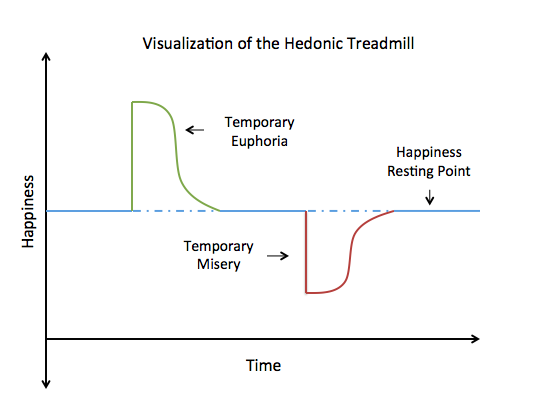
Image Source kadampalife


Hedonic Treadmill

It is the exact same reason the concept is also referred to as the Hedonic Treadmill. We are running on a treadmill, trying to maintain the state of euphoria by chasing Instagram likes, buying new things, searching for those 15 minutes of fame. But alas, this survivalist brain of ours brings us back to where we started.  


I read a very interesting example today about this - We can now purchase and download all our favorite songs on our phones and can, and actually do listen to them whenever we want. But does it give the same burst of excitement if the song unexpectedly comes on the radio or you hear it being played in a car passing by?


This example can really be tied to the age-old adage that we hear from monks and minimalists. Experience over Things.   


Once you own a song, after the first few times, your brain knows it resides in your pocket, and you can listen to it anytime. Meh. Takes away the excitement. While, as is the case with all experiences, listening to it on the radio is a once in a while event, can not be done on-demand and actually has a surprise element to it! 


Can we alter the baseline?


I often found myself asking the following two questions during the lectures:


How did my happiness / life satisfaction baseline get set to a specific level? 


To be honest, I didn't find much conclusive answer to this question. Some studies say almost 50% of the weight is on genetics, the next 10% is on the conditions you have grown up in, and the rest 40% is what kind of personality we have, our thoughts, values, and so on. I figured, the baseline doesn't matter, if I can find an answer to the second question 


How do I play around with it? 


 Professor Laurie Santos gave several good pointers, but the following ones struck a chord with me. 

  • Savoring:  The act of stepping outside of an experience to review and appreciate it 
While having an experience, step out of it and realize that this activity was probably your dream for years, what seems like an unordinary thing now

  • Gratitude The quality of being thankful and a tendency to show appreciation for what one has 

Sounds like a small thing, but writing down 3-5 things every day that you are thankful for increases your happiness baseline for weeks! And sharing your gratitude with a person can yield months of increased baseline. 

And this method is Dwight Schrute approved as well 


And the last one, which was quite a counterintuitive one for me. Interrupt your positive experiences, and savor them by enjoying them in multiple sittings.


I actually didn't understand this one quite well, till I heard the subsequent example: Were TV shows much more exciting when we had to wait 1 week for the next episode, which was even further interrupted with advertisements? Or are they more enjoyable now with them playing in such uninterrupted mode than even Netflix has to ask - Are you really still watching this show?

Ending Notes

I still have about 3 weeks of the course to go. Will add here or in a new post if I find more such interesting nuggets. For now, I will leave you with my favorite quote of the week.


    A new car sticks around to disappoint you. But a trip to Europe is over. It evaporates. It has the good sense to go away, and you are left with nothing but a wonderful memory. --Dan Gilbert


    Monday, 12 October 2020

    What is minimalism?

    Like most of you, I spent the better part of 2020 in my pajamas, wearing the same 4-5 t-shirts throughout the lockdown and wondering about a lot of existential questions. Obviously, after exhausting the whole catalogue of Netflix. 


    With an extra 2-3 hours extra per day, thanks to reduction in travelling time - to and fro from work - I was able to dedicate a lot more time to reading. In addition to the usual financial markets stuff, I was forced to read a wide variety of topics just to keep myself engaged. 


    To my surprise, one of the topic that stuck started with reading en vogue book of the year by Marie Kondo. Though I also read a lot about the first principles behind it - the Zen way of life, minimalism, meditation and as Po would call it "inner peace". The only one that stuck was Minimalism.


    To be fair, we are not monks. We cant renounce stuff and live life like master Oogway. We must take what is good and practical to apply and enrich our life. 


    So how do you actually define Minimalism?

    First I present you the definitions from the learned ones, and then mine.


    Maybe you don’t need to own all this stuff. - Joshua Becker's Neighbor


    Minimalism is defined as a design or style in which the simplest and fewest elements are used to create the maximum effect. Minimalism had its origins in the arts—with the artwork featuring simple lines, only a few colors, and careful placement of those lines and colors - Andrew Ongaro 


    Minimalism is a tool to rid yourself of life’s excess in favor of focusing on what’s important—so you can find happiness, fulfillment, and freedom - The Minimalists


    It’s a way to escape the excesses of the world around us — the excesses of consumerism, material possessions, clutter, having too much to do, too much debt, too many distractions, too much noise. But too little meaning.  - Leo Babuta of the Zen Habits


    My definition is a derivation from the work of all these masters, and my MBA degree - Dude, its just Pareto Principle. Only 20% is enough to get 80% of the results! While we know this for business world, it is equally applicable in personal world as well.


    Plant
    Photo by Sarah Dorweiler on Unsplash


    Being a certified data nerd, I tried collecting some random samples to test this out

    - We have 8 HDMI cables at home but only 2 ports in the TV

    - Got 5 suits, but only wear 1 lucky one for all key meetings [not taking questions on this one]

    - More than 50% of the contents of the wardrobe were not used in the last 1 year

    - iPhone has actually unloaded 35 apps of the total 50+ on due to long-time-no-see

    - Don't even remember where do I know from ~500 friends on Facebook

    - Not even going to do the same exercise for LinkedIn - already know the results will be worse

    ... and a lot more 


    Certainly begs a question or two?

    1) Does it matter - Yes, it does. Believe it or not, most of us are dealing with a cognitive overload. Too many processes running at the same time, leading to less than optimum resources being provided to the essential ones. 


    For the same reason you see most influential CEOs always wearing same clothes - less optionality, less cognitive overload for non essential stuff. 


    To take an example from your daily life, the famous words of IT helpdesks - did you try restarting it? The simplest solution to complex problems, as it simply shuts down all unnecessary processes that the laptop started in parallel during the day! 


    2) What should you do about it - I have no idea, what you should do, but here are some things I am working on

    - Start discarding some of my possessions [ideal target is one item per day]
    - Reduce stock portfolio to less than 20 stocks
    - Try saying no to at least 3 meetings per week
    - Reducing time spent / connections on social media 
    ... and some more


    My goal is to try 30 day minimalism game, but that is a very hard one. As of now, I am on baby steps of the process :)


    See you next time with more updates! 

    Wednesday, 29 August 2018

    Student Loans Endemic

    First things first: In the past few years, no other image has brought me as much joy and mental peace as this one:
    student loan screenshot
    ~~~Closure notice of my student loan account~~~
    Ever since my graduation in June 2016, closing the student loan has been - you can say - my singular focus in life! While the loan payments were quite manageable for our household budget, just looking at the sheer size of the debt in 2016 used to nauseate me. 

    Leverage

    For those who have undergone any form of finance or business courses, leverage is usually one of the first topics that they learn about. In investing terms, leverage basically refers to the act of seeking higher profits by investing borrowed money (source). The courses then go into the detail of adjusting your extra returns with the cost of capital (interest) and the tax benefits you get on the interest paid. Net-net, on paper, it is a brilliant idea to leverage to grow rapidly - IF you have a consistent cash flow. Mind that IF in bold, underlined font. 

    Leveraging, or taking out a student loan, for international higher studies course is indeed an interesting option, but considering the current economic conditions, increasing protectionism and volatility in general makes it the second most risky investment you can make in the recent times. First, of course, is investing in crypto-currency! Well, don't even get me started on crypto! 

    Recently, I read some of the most beautiful words written about leverage (source)

    Body size in biology is like leverage in investing: It accentuates the gains but amplifies the losses. It works well for a while and then backfires spectacularly at the point where the benefits are nice but the losses are lethal

    Optionality

    Along with increasing the risk, I believe, any form of regular, mandatory payment decreases your optionality. Especially in case of student loans, as your repayment term begins, you are forced to find a paying job, or let go of any start-up ideas that you were pursuing. While one may or may not exercise any optionality, it is always at the back of your head to be in a stable, secure life with cash flows exceeding loan repayments at the bare minimum. 

    Having said that...

    And, after closing down on the juggernaut sized loans, I can now say that this leveraged trade was one of mybest trades with quite high ROI. Not only I have changed my industry and geography (of the 3 famed traits that define your job: geography/industry/function), but it gave me incredible opportunity to settle down in the city of Paris! AND, that puts us in close proximity of almost the whole of Europe for mini-sojourns

    In a nut-shell...

    What I am trying to say is leverage is risky! If everything works out - awesome! But in most of the cases, it is taken on by students, in disproportionate amount vs. their own assets, and with no clear visibility on future cash flows. Compound that with volatile geopolitical and protectionist environment of today, it is not a figment of my imagination that student loan debt will be the next burst bubble, similar to that of 2008.

    Monday, 21 August 2017

    My watch is ended

    Keeping up with the Game of Thrones theme, as with most of our conversations these days, I recently used the epic half-liner from previous season “My watch is ended” with my wifey to remind her of:

    • The batteries of my watch have died again: even though I have been wearing wrist watches for over 20 years now, I have no idea how long are the batteries of a watch are supposed to last! Empirical evidence suggests anywhere between 6 months and 10 years, depending upon the weather conditions on Mars during that period! 
      • Side note: I can never ever wear a watch that needs charging every night! Even though I would love to, but for the foreseeable future I am not going to try any smart watch 
    • She got her first French salary (yippie!) and as per the tradition, she needs to buy me a ceremonial gift! 

    For the impatient readers, Tl; Dr version of the outcome of that discussion is: after hours of research and keeping in line with my personal preference towards not charging a personal device for as long as humanly possible, we bought this beautiful piece of Fossil Mechanical watch! Just look at the video and appreciate all the intricate machinery slowly humming along inside!

    A post shared by abby khanna (@furobiker) on


    For the patient ones, I did some research on types of watches and how to select a good watch. While selecting a watch is a matter of personal taste, I have documented here various types of watches available in the market so that you guys can make more informed decisions in the future: 

    Types of Watches: 

    Based on the “movement” (a.k.a “calibre” or the basic mechanism driving the watch and the associated functions, also referred to as ‘complications’, such as calendar, multiple time zone features etc.) a watch can be categorized into two basic categories: Quartz movement or Mechanical movement. Various manufacturers implement these movements using their own styles/techniques, but essentially these two kinds of movements are building blocks for all kinds of watches: 

    How to find out if the watch is quartz or mechanical: 

    Just look at the seconds’ hand! If it is making clear jumps between seconds, it is a quartz watch, if it is making a sweeping motion or several tiny jumps between seconds, it is a mechanical watch. 

    Source: https://i0.wp.com/www.precisionwatches.com/wp-content/uploads/2016/05/quartz-vs-mechanical-watch-movement-gif-1.gif?fit=734%2C200&ssl=1

    Quartz Movement:

    Powered by a battery, watches based on quartz movement are pretty accurate and require much less maintenance than mechanical watches. Just an occasional battery replacement and it is good to go. Typically, quartz watches are much less preferred by watch enthusiasts due to lack of craftsmanship and technology or engineering prowess in designing intricate parts. 

    Mechanism: 

    Simply put, the battery sends current through a quartz crystal (hence the name quartz movement). The current electrifies the crystal, which in turn vibrates. These vibrations create the movement to drive the watch motor, which in turn drive watch hands. These watches run quite accurately till the time battery is providing ample current to the crystal. As the battery starts running out of juice, you will notice that the watch has started losing time. 

    Mechanical Movement: 

    Powered by a wound spring, most of the luxury watches run on mechanical movement. In a lot of mechanical watches (for example in the video above), there is a provision to witness and appreciate the intricate components, working together in a tightly woven configuration to power the watch. Several super-luxury watches still have hand-crafted intricate parts, designed for a snug fit and supposed to work fine for decades. 

    Mechanism: 

    Mechanical movement watches store energy in a wound spring. The spring transfers energy to gears and sometimes other springs to provide regulated power to the watch hands. I am assuming your next question would be: From where does the wound spring gets its energy from? Good question! 


    Types of mechanical watches: 

    Manual: Remember the typical watch our grandparents wore? They were rotating the crown on the side of the watch to wind up the spring. The energy is stored in the spring and is typically enough for ~24-hour period. Though some of the newer watches may store enough energy for ~2-day period. 

    Automatic: Automatic watches also have the option of rotating the crown to wind up the spring. However, they also have a metallic weight (called rotor), which is free to move when the body of the watch moves. So, when you walk or move your wrist, the metallic rotor moves, winding the spring. Hence, when you wear it daily, there is no need to wind up the spring, as it gets automatically wind up when you walk or move your hands. 

    ... and 

    Well, that was a brief overview of different types of watches. Personally, mechanical watches interest me more, especially where the mechanism is visible through the front glass. If you are interested in the engineering behind watches you can also look at how basic gearing works in such watches and how different manufacturers add complexities (in simple terms – features) to their respective products.

    Let me know if you found this brief note useful! 

    Monday, 31 July 2017

    Getting back to writing


    Last week, I was out for a formal dinner with some colleagues. Amid regular getting-to-know questions, one that stood out to me was “What do you do outside of the office?” Even though I am busy from the moment I wake up, to the time when I finally switch off my phone and sleep, I realized that day that since past couple of years, I have not worked on any of my specific hobbies or a personal project!

    Side note: Apparently, playing games on X-box or assembling so many pieces of furniture for your new house that one can easily qualify any carpentering exams does not count. 

    I started remembering the things I liked and the side projects I worked on during me pre-MBA life in India. Travelling – it is something I do to relax, not as a personal project. Reading – sure, but the number of books I have read in 2017 stands at 3. Writing – the last time I wrote on this blog was over 12 months ago! Coding – I have quit more times than I have started! Running – Although, I increased my stamina to go up to 12kms in one go, I have not been regular in the last 7-8 weeks. 

    The same night, I went out to buy a mop to clean up the spider-webs from this blog. Currently, I am going through quite an exciting period in my life, and if I properly get down to jotting some nice experiences, I can fill up a few hundred pages! So, why not! 

    When I started this blog page a few years ago, I decided that everything I write here should be either:


    Something I am knowledgeable about


    About a year and a half ago, I switched careers – from a procurement advisory function, I have moved full time to an energy management and automation firm. This is a completely new industry for me, and I am picking up new things daily. I have a lot of stuff in my head to write about – renewable energy (especially solar) and its impacts on the grid, building management systems with the focus on energy efficiency, automation and digitization of the manufacturing industry, 3D printing to name a broad few topics.

    Every time I pick up a notepad (yes, I am old school when it comes to writing) to write about these topics, I feel quite underwhelmed with the things I know vs. the things there are actually worth knowing about the topics I am going to write about. If you look at the chart below, I am currently hovering over the valley of despair!


    Dunning Kruger Effect

    Something I am learning about


    The target at the very top of my mind is my slow progress on learning the French language. I am doing ok in reading newspaper level French, however, when it comes to speaking and more importantly listening to French, I fall flat on my face. There is nothing worth writing on this topic, but just leaving it here as a casual reminder to self. 

    The other thing I am learning is nuggets of history about the things I like and the things I am discovering. Just in the past quarter, I have learnt about the The Ashes Cup while touring The Lord's stadium in London, the fine art of making scotch while touring The Glenlivet distillery in Scotland, life of Pablo Picasso and the depiction of his state of mind through his paintings in Musée national Picasso (Picasso museum) in Paris, among tens of other things. 

    Wait, these all sound pretty solid ideas to pen down what I learnt, remembered and then augment with external research! 

    Alright, back to work now! Till we meet again next week!

    Labels

    2014 (2) 2015 (5) 2016 (3) 2017 (3) 2018 (3) 2020 (2) MBA Life (9) finance (2) learning (5) minimalism (3)